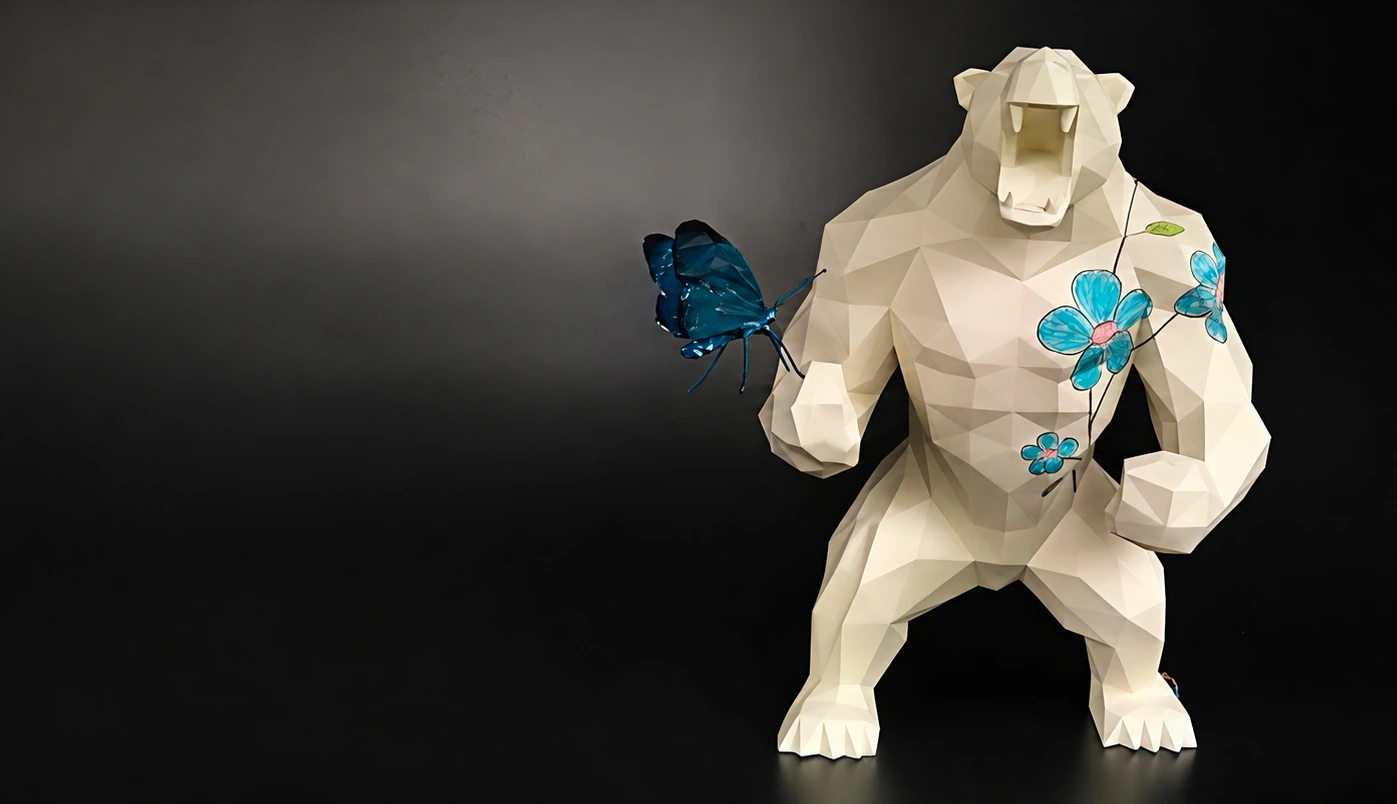
The first flower had already left a mark.
In The First Flower — Spring I, the Young King encountered something outside himself and carried a trace of that encounter onto his own body.
Spring II begins after that first discovery.
The flower is no longer entirely new.
The Butterfly is no longer simply a passing presence.
And the surface of the Young King is no longer untouched by experience.
Something has begun.
Now it continues.
The First Flower — Spring II is the second seasonal work in The First Flower, the childhood chapter of The Young King Universe created by Vietnamese artist Vo Anh Tuan.
Here, the language first established in Spring I begins to change.
The flower grows from a simple stem into something more structured.
A branch appears.
The memory is beginning to develop a form of its own.
After the first flower
A first encounter can never happen twice.
Once the Young King has seen the flower, the next flower cannot be experienced in exactly the same way.
Something has changed.
He now carries a memory of what came before.
This is the quiet difference between Spring I and Spring II.
Spring I belongs to discovery.
Spring II belongs to continuation.
The Young King is still a child.
He is still responding directly to the world.
But the world is no longer completely unfamiliar.
One experience has begun to stand beside another.
And with that, a sequence begins to form.
From stem to branch
The flower language changes in Spring II.
In Spring I, the flower remains close to a simple grass-like stem.
In Spring II, the structure becomes more woody.
A branch supports the flower.
This is a small visual change, but within the sequence it matters.
The flower has not become more important because it is more complex.
Rather, the visual language is beginning to evolve alongside the Young King's experience.
The world he is seeing is gaining detail.
What began as a simple encounter is becoming part of a growing vocabulary.
Stem.
Branch.
Flower.
Color.
Memory.
None of these elements needs to be explained to the Young King.
He simply encounters them.
Drawing without becoming decoration
As in Spring I, wax crayon remains central to the physical language of the work.
The marks retain pressure.
Irregularity.
Uneven edges.
The evidence of a hand.
They are allowed to remain different from the controlled geometry of the sculpture beneath them.
This contrast is important.
The sculptural body of the Young King is deliberate and constructed.
The drawings upon it are immediate.
One belongs to form.
The other belongs to gesture.
Spring II allows these two languages to exist together without forcing one to imitate the other.
The sculpture does not become a canvas in the conventional sense.
The marks remain evidence that something happened there.
The body carries more than form
When the Young King first appeared in Genesis Core III — Primal Form, his body represented emergence.
By Spring II, that body has begun to carry history.
Not a long history.
Not yet.
But enough that the surface can no longer be understood only as form.
There was a time before the flower.
There was Spring I.
Now there is Spring II.
Each work adds something that the previous state did not contain.
This is how the Young King's body begins to become a living record of experience.
Not because every memory is deliberately archived by the child,
but because traces remain after moments have passed.
The Butterfly remains
The Butterfly continues to stay near the Young King.
Its presence is becoming familiar.
That familiarity changes the relationship.
The first appearance of something may create surprise.
Its return creates recognition.
The Butterfly still does not explain itself.
It does not become a teacher through words.
It remains part of the Young King's early world through presence.
For a child, this may be enough.
Some relationships begin not with understanding, but with repeated nearness.
And repeated nearness can become memory.
Learning through repetition
Children repeat things.
They draw the same shape again.
They return to something they like.
They discover that what appears similar is never completely the same.
Spring II belongs to this kind of learning.
The Young King does not need a new universe for every new experience.
Sometimes growth happens by returning to something already encountered and seeing that it has changed.
Or perhaps realizing that he has changed.
The flower returns.
But it is not the first flower anymore.
The Young King returns to drawing.
But it is not the first mark anymore.
Repetition has begun to accumulate difference.
A sequence begins to matter
One artwork can preserve a moment.
Two artworks begin to establish a relationship between moments.
This is where Spring II becomes important within The First Flower.
Spring I can now be remembered because Spring II exists after it.
There is a before.
There is an after.
The difference between them becomes visible.
The flower has changed.
The drawing has continued.
The Young King has carried one experience into another.
This is how chronology begins to become more than a list of works.
It becomes evidence of a life moving forward.
The world is becoming familiar
At the beginning of The First Flower, the Young King encounters the world with almost no history behind him.
By Spring II, a small amount of familiarity has appeared.
A flower is no longer entirely unknown.
The Butterfly is no longer entirely new.
Drawing is no longer an action happening for the first time.
But familiarity does not remove wonder.
It changes its form.
The Young King can return to something and still find another way of seeing it.
That may be one of the earliest forms of learning.
Not replacing the first experience.
Building upon it.
What Spring II leaves behind
Spring II does not need to announce a transformation.
Its change is quieter.
A simple stem has become a branch.
A first trace has become part of a sequence.
A presence has begun to feel familiar.
A body has begun to carry more than one moment.
Nothing here is monumental.
That is precisely why it belongs to childhood.
Growth is often visible only when one moment is placed beside another.
Spring I gave the Young King his first trace of the flower.
Spring II allows that trace to continue.
And somewhere between the two,
the beginning of a memory has started to become a history.
ARTICLE 007
The Young King Journal
Vo Anh Tuan · The Young King Universe