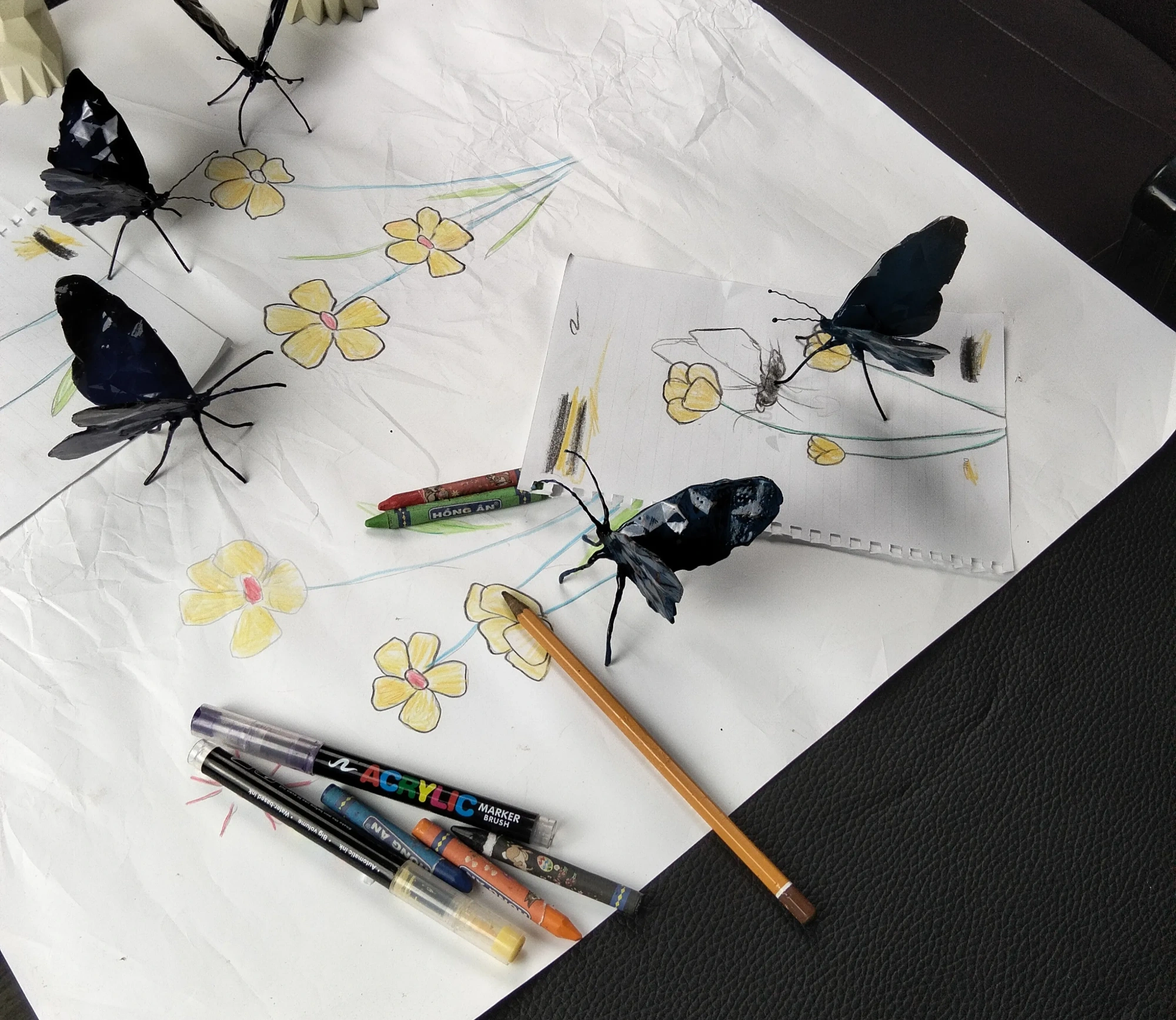
Before The First Flower — Summer I entered the body of the Young King, it began on paper.
Flowers were drawn, repeated and altered.
Lines were tested.
Colours were placed beside one another.
A small sun appeared among the sketches.
And around the working surface, the Butterfly remained present.
Summer did not begin with a finished image.
It began through looking, drawing and deciding.
From Spring to a New Season
The first three works of The First Flower belonged to Spring.
By Summer I, the visual language needed to move forward without losing what had already been established.
The flowers could not suddenly become sophisticated.
They still had to belong to the hand of a child.
Their five-petal structure remained simple.
Their stems remained direct.
The wax crayon marks remained imperfect.
But Summer required more energy.
The flowers needed to feel stronger.
The season had changed.
Drawing Before the Sculpture
The working drawings for Summer I were not intended as polished botanical studies.
They were tests of memory, simplicity and rhythm.
Some flowers were drawn with long stems.
Some were repeated at different sizes.
Their outlines remained uneven.
Colour did not always remain perfectly inside the form.
These imperfections were important.
The purpose was not to design a decorative floral surface.
It was to find marks that could still feel immediate when transferred onto the body of the Young King.
The Arrival of the Sun
Summer I also introduced a new symbol into The First Flower:
the sun.
In this first Summer work, it appears on the chest of the Young King.
Like the flowers, the sun is deliberately simple.
A circle.
A few rays.
A child's direct understanding of light.
Its role is not decorative.
It marks the beginning of a new seasonal movement.
Spring had brought growth.
Summer begins to bring light.
Wax Crayon as a Living Surface
Wax crayon remains the drawing material throughout The First Flower.
For Summer I, this material continues to matter precisely because it is vulnerable.
The surface is not varnished into perfection.
The crayon remains exposed.
Its pressure, texture and irregularity remain visible.
The final marks therefore carry something of the moment in which they were made.
They are not only images of flowers.
They are traces of an action.
The Butterfly Nearby
The Butterfly has existed within The Young King Universe from its earliest memories.
Silent and without explanation, it appears as a guide rather than a narrator.
During the making of Summer I, its presence around the working process creates a quiet connection between the physical act of making and the larger chronology of the Young King.
It does not need to explain the flowers.
It simply remains nearby.
From Drawing to Body
The most important decision came when the drawings left the paper.
A flower that works in a sketchbook does not automatically work on a sculpture.
The body has volume.
It has direction.
It has areas that need activity and areas that need silence.
Every mark therefore had to respond to the physical form of the Young King.
The sculpture remained primary.
The drawings had to belong to it.
Not cover it.
Not disguise it.
Not turn it into a decorative object.
This balance became the foundation for Summer I.
The First Summer Work
When the drawings finally entered the sculpture, Summer I became the first completed Summer record within The First Flower.
The flowers had grown stronger.
The sun had appeared.
The wax-crayon language remained childlike.
And the Young King had moved into a new season.
What began as drawings on paper became part of the chronology of the universe.
One mark at a time.
One flower at a time.
One season at a time.
Stories may return.
Characters may return.
Moments never return.