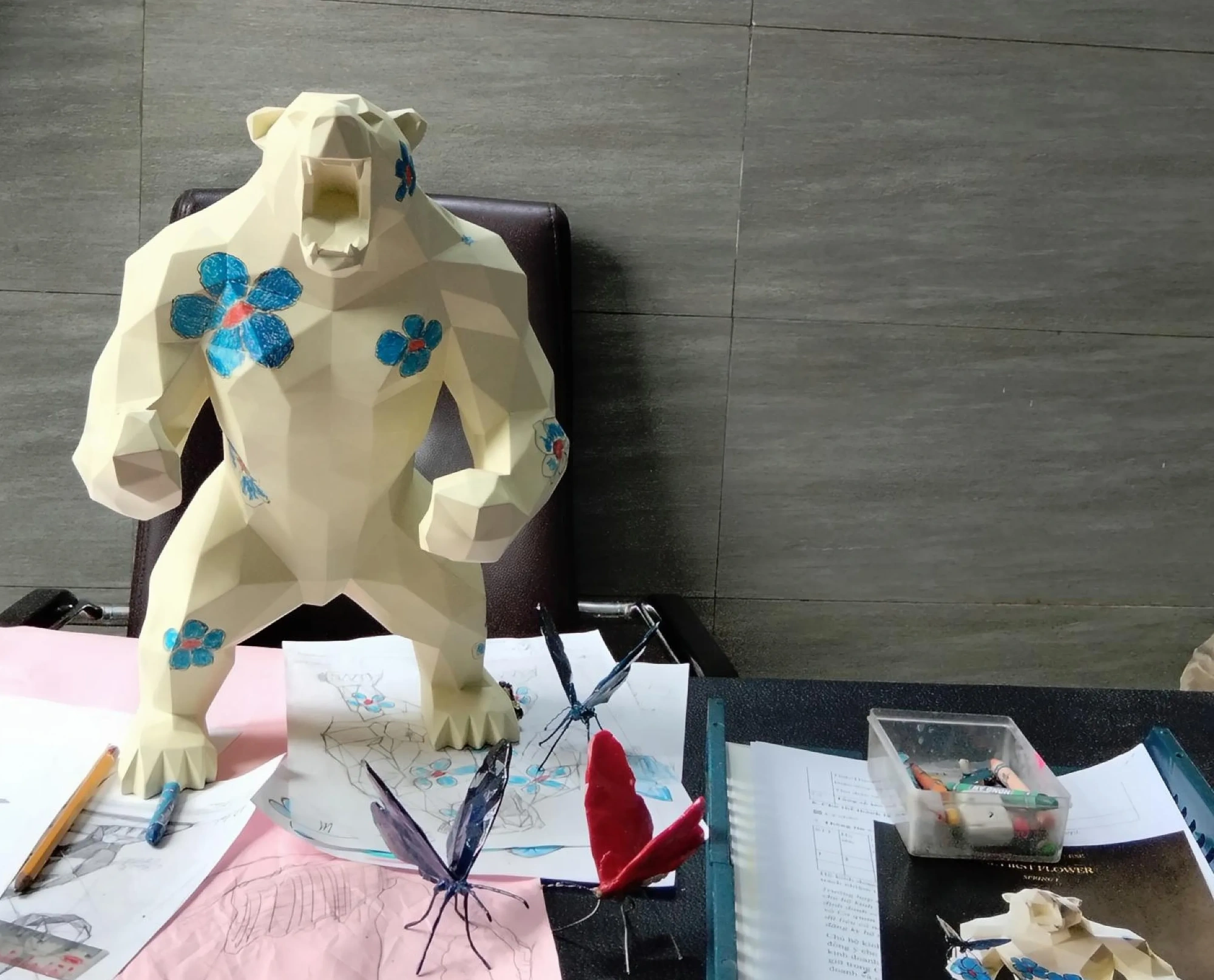
Spring I introduced a flower rising from a grass-like stem.
Spring II allowed that structure to develop into a woody branch.
For Spring III, the direction changed.
Rather than adding another layer of growth, the supporting botanical structure was removed. There would be no stem and no calyx.
Only the flower would remain.
This reduction became the central decision in the making of Spring III.
The flower had to retain the same childlike visual language established in the earlier works while becoming independent from the structure that had previously supported it. Its presence now depended entirely on the simplicity of its shape, color and placement on the body of The Young King.
Wax crayon remained the material of the drawing.
Its lines were allowed to remain direct and imperfect, preserving the quality of a mark made by hand rather than refining it into a polished illustration. The crayon surface was left uncoated so that its material character remained visible as part of the work.
The making of Spring III therefore became an exercise in reduction.
Nothing needed to be added simply because the sequence was progressing.
Instead, something could disappear.
Across the three Spring works, the flower moves through three distinct conditions:
Spring I — a flower with a simple stem.
Spring II — a flower growing from a woody branch.
Spring III — the flower alone.
By removing the stem and calyx, Spring III completes the first seasonal sequence through simplicity rather than complexity.
The flower has not grown larger.
It has become independent.